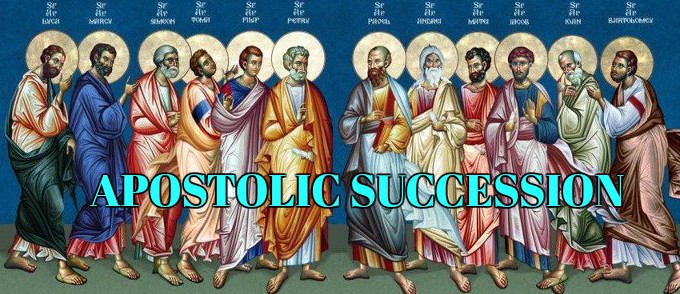
|
Apostolic
Succession
Hebrews 3:1 (KJV)
1
Wherefore, holy brethren,
partakers of the heavenly calling,
consider the Apostle and High Priest of
our profession, Christ Jesus;
Mark
3:13-19 (King James Version)
13
And he
(JESUS)
goeth up into a mountain, and calleth
unto him whom he would: and they came
unto him.
14
And
He
ordained twelve,
that they should be with him, and that
he might send them forth to preach,
15
And to have
power to heal sicknesses, and to cast
out devils:
16
And Simon he
surnamed Peter;
17
And James
the son of Zebedee, and John the brother
of James; and he surnamed them Boanerges,
which is, The sons of thunder:
18
And Andrew,
and Philip, and Bartholomew, and
Matthew, and Thomas, and James the son
of Alphaeus, and Thaddaeus, and Simon
the Canaanite,
19
And Judas
Iscariot, which also betrayed him: and
they went into an house.
Acts 8:14-25
(King James Version)
14
Now when the
apostles which
were at Jerusalem heard that Samaria had
received the word of God, they sent
unto them Peter and John:
15
Who, when
they were come down, prayed for them,
that they might receive the Holy Ghost:
16
(For as yet
he was fallen upon none of them: only
they were baptized in the name of the
Lord Jesus.)
17
Then
laid they their hands on them, and they
received the Holy Ghost.
Ephesians
4:7-16 (King James Version) (Gifts
Given To The Church)
7
But unto every one
of us is given grace according to the
measure
of the gift of Christ.
8
Wherefore he saith,
When He ascended up on high,
he led
captivity captive, and gave gifts unto
men.
9
(Now that he
ascended, what is it but that he also
descended first into the lower parts of
the earth?
10
He that
descended is the same also that ascended
up far above all heavens, that he might
fill all things.)
11
And he
gave some,
apostles; and some, prophets; and
some, evangelists; and some, pastors and
teachers;
12
For the
perfecting of the saints,
for the work of the ministry, for the
edifying of the body of Christ:
13
Till we all
come in the unity of the faith,
and of the knowledge of the Son of
God, unto a perfect man, unto
the measure of the stature of the
fulness of Christ:
14
That we
henceforth
be no more
children,
tossed to and
fro, and carried about with every wind
of doctrine, by the sleight of men, and
cunning craftiness, whereby they lie in
wait to deceive;
15
But speaking the truth in love, may grow up into him in
all things, which is the head, even
Christ:
16
From whom
the whole body fitly joined together and
compacted by that which every joint
supplieth, according to the effectual
working in the measure of every part,
maketh increase of the body unto the
edifying of itself in love.
(plural
A·pos·tles)
noun
| |
one of Jesus Christ's
disciples: any of the 12
followers of Jesus Christ chosen
by him to preach the news about
Christianity |
Microsoft® Encarta® 2006.
© 1993-2005 Microsoft Corporation. All
rights reserved.
Apostle
Greek Strong's Number:
652
Greek
Word:
ἀπόστολος
Transliteration:
apostolos
Usage Notes:
English Words used in KJV:
apostle 78
messenger 2
he that is sent 1
[Total Count: 81]
from
<G649> (apostello); a delegate;
specially an ambassador of the
Gospel; officially a commissioner
of Christ [“apostle”] (with
miraculous powers) :- apostle,
messenger, he that is sent.
Strong's Talking Greek & Hebrew
Dictionary.
| |
Christian doctrine of
bishops' authority: the
doctrine of some Christian
denominations that the
ordination of bishops follows in
an unbroken line of succession
from the Apostles, providing the
basis of their spiritual
authority |
Microsoft® Encarta® 2006.
© 1993-2005 Microsoft Corporation. All
rights reserved.
|
Apostolic
Succession
From
Wikipedia,
the free
encyclopedia
Apostolic
Succession
is the
doctrine
in some
of the
more
ancient
Christian
communions
that the
succession
of
bishops,
in
uninterrupted
lines,
is
historically
traceable
back to
the
original
twelve
Apostles[1]
Within
Catholic
Christianity
it "is
one of
four
elements
which
define
the true
Church
of Jesus
Christ"
[2]
and
legitimizes
the
existing
sacramental
offices,
as it is
considered
necessary
for a
bishop
to
perform
legitimate
or
"valid"
ordinations
of
priests,
deacons,
and
other
bishops.
Apostolic
succession
is
transmitted
during
episcopal
consecrations
(the
ordination
of
bishops)
by the
laying
on of
hands
of
bishops
previously
consecrated
within
the
apostolic
succession.
This
lineage
of
ordination
is
traceable,
according
to the
Catholic
Church,
to the
original
Twelve
Apostles,
thus
making
the
Church
the
continuation
of the
early
Apostolic
Christian
community.
The
Catholic
Church,
as well
as the
Eastern
Orthodox
churches,
Oriental
Orthodox
churches,
the
Assyrian
Church
of the
East,
the
churches
of the
Anglican
Communion,
the
Old
Catholic
Church
all
claim
apostolic
succession,
as do
some
Lutheran
churches
in some
Scandinavian
countries,
the
Mar Toma
Christians
in
India,
and the
Polish
National
Catholic
Church,
with
60,000
members.[3]
While
the
Anglican
claim of
apostolic
succession
is
recognized
by some
Eastern
Orthodox
churches,
it is
not
officially
recognized
by the
Catholic
Church,
based on
Pope Leo
XIII's
papal
bull
Apostolicae
Curae.
However,
since
the
promulgation
of
Apostolicae
Curae,
Anglican
bishops
have
acquired
Old
Catholic
lines of
apostolic
succession
recognized
by Rome.
As a
general
rule,
Protestantism
rejects
the
doctrine
of
apostolic
succession,
and as
such
they
have no
traceable
lineage
to the
Apostles
like the
more
ancient
Christians,
such as
those of
the
Catholic
Church
or the
Eastern
Orthodox
churches.
Due
to the
sacramental
theology
of these
churches,
only
bishops
and
presbyters
(priests)
ordained
by
bishops
in the
apostolic
succession
can
validly
celebrate
or
"confect"
several
of the
other
sacraments,
including
the
Eucharist,
reconciliation
of
penitents,
confirmation
and
anointing
of the
sick.
Apostolic
succession
is an
important
dividing
line to
those
who
claim
it: the
lack of
it is
the main
reason
Protestant
communities
are not
considered
churches
by the
Orthodox
churches
and the
Roman
Catholic
Church.[4]
Eastern
Orthodox
theology
and
ecclesiology
teaches
that
each
bishop
is equal
to the
other
bishops,
even the
Ecumenical
Patriarch,
who is
first
amongst
equals.
The
Roman
Catholic
Church
and many
early
Christian
writers
teach
that
Jesus
gave
Saint
Peter
a unique
primacy
among
the
apostles.
Roman
Catholics
teach
that
this has
been
passed
on in
the
office
of the
Papacy
despite
Saint
Peter
having
been the
Bishop
of
Antioch
before
completing
his
episcopacy
in Rome.
"If
the very
order of
episcopal
succession
is to be
considered,
how much
more
surely,
truly,
and
safely
do we
number
them
from
Peter
himself,
to whom,
as to
one
representing
the
whole
Church,
the Lord
said,
‘Upon
this
rock I
will
build my
Church’
. . .
[Matthew
16:18].
Peter
was
succeeded
by Linus,
Linus by
Clement,
Clement
by
Anacletus,
Anacletus
by
Evaristus
. . . "
(St.
Augustine;
Letters
53:1:2
[A.D.
412]).
"The
Lord
says to
Peter:
‘I say
to you,’
he says,
‘that
you are
Peter,
and upon
this
rock I
will
build my
Church,
and the
gates of
hell
will not
overcome
it. ...
’ [Matt.
16:18].
On him
[Peter]
he
builds
the
Church,
and to
him he
gives
the
command
to feed
the
sheep
[John
21:17],
and
although
he
assigns
a like
power to
all the
apostles,
yet he
founded
a single
chair
[cathedra],
and he
established
by his
own
authority
a source
and an
intrinsic
reason
for that
unity. .
. . If
someone
[today]
does not
hold
fast to
this
unity of
Peter,
can he
imagine
that he
still
holds
the
faith?
If he
[should]
desert
the
chair of
Peter
upon
whom the
Church
was
built,
can he
still be
confident
that he
is in
the
Church?"
(Cyprian
of
Carthage;
The
Unity of
the
Catholic
Church
4; first
edition
[A.D.
251]).
[5]
Apostolicity
as
doctrinal
continuity
| “ |
Let them produce the original records of their churches; let them unfold the roll of their bishops, running down in due succession from the beginning in such a manner that [that first bishop of theirs] bishop shall be able to show for his ordainer and predecessor some one of the apostles or of apostolic men[6] |
” |
|
—Tertullian |
While
many of
the more
ancient
Churches
within
the
historical
episcopate
state
that
Holy
Orders
are
valid
only
through
apostolic
succession,
most of
the
various
Protestant
denominations
would
deny the
need of
maintaining
episcopal
continuity
with the
early
Church.
They
generally
hold
that one
important
qualification
of the
Apostles
was that
they
were
chosen
directly
by Jesus
and that
they
witnessed
the
resurrected
Christ.
According
to this
understanding,
the work
of the
twelve
(and the
Apostle
Paul),
together
with the
prophets
of the
twelve
tribes
of
Israel,
provide
the
doctrinal
foundation
for the
whole
church
of
subsequent
history
through
the
Scriptures
of the
Bible.
To share
with the
apostles
the same
faith,
to
believe
their
word as
found in
the
Scriptures,
to
receive
the same
Holy
Spirit,
is to
them the
only
meaningful
"continuity"
with
what
they
believe
the
early
Christians
to have
believed,
because
it is in
this
sense
only
that men
have
fellowship
with God
in the
truth
(an
extension
of the
new
Reformation-era
doctrines
of
sola
fide
and
sola
scriptura).
The most
meaningful
apostolic
succession
for most
Protestants,
then, is
a kind
of
"faithful
succession"
of
apostolic
teaching.
There
is, of
course,
much
disagreement
among
various
Protestant
denominations
about
the
exact
content
of
apostolic
teaching,
ranging
from
fundamental
doctrinal
disagreements
to
lesser
side-issues.
In
addition,
some
Protestants
state
that the
teaching
of
apostolic
succession,
according
to their
interpretation,
is not
found in
the
Bible,
so it
isn't
necessarily
true.
It is
worth
noting,
however,
that the
First of
the
Epistles
of
Clement
which is
commonly
dated to
the
first
century
and
claims
to be
written
by the
Roman
Church
(the
chair of
St.
Peter
and the
center
of the
unity of
the
Church,
according
to
Catholic
doctrine)
which
was
established
by the
Apostles
presents
a belief
in
apostolic
succession
as do
also the
Epistles
of
Ignatius
of
Antioch,
who was
a
personal
disciple
of the
Apostles
John and
Paul.
Also
worth
noting
is the
fact
that
others
beside
the
twelve
Apostles
and
Saint
Paul are
called
"Apostles"
in the
New
Testament.
Also
noteworthy
is the
fact
that the
Apostle
Paul,
though
given
spiritual
authority
directly
by
Christ,
did not
embark
on his
apostleship
without
conferring
with
those
who were
apostles
before
him as
he notes
in his
Epistle
to the
Galatians.
By
contrast,
some
Protestant
charismatic
and
restorationist
movements
include
"apostles"
among
the
offices
that
should
be
evident
into
modern
times in
"a true
church",
though
they
never
trace an
historical
line of
succession
or
attempt
to
confer,
like
Paul,
with
those
who were
"apostles"
before
them. It
is
frequently
the case
that the
founders
or
senior
leaders
of a
restorationist
church
grouping
will be
referred
to as
the
apostles,
and they
may have
been
ordained
by
self-ordination,
or
merely
appointed
by a
congregation.
"Church
planting",
according
to the
Restorationist
Movement,
is seen
as a key
role of
these
present-day
apostles,
but the
concept
of
apostolic
succession
which
protected
the
faith
and
inter-communion
of the
original
Church
through
the
first
three
centuries
of
persecution
and
cross-cultural,
translinguistic
evangelism
has been
lost in
these
new
movements.
Those
who hold
to the
importance
of
episcopal
apostolic
succession
would
counter
the
above by
appealing
to the
New
Testament,
which,
they
say,
implies
a
personal
apostolic
succession
(from
Paul
to
Timothy
and
Titus,
for
example)
and
which
states
that
Jesus
gave the
Apostles
a "blank
check"
to lead
the
Church
as they
saw fit
under
the
guidance
of the
Holy
Spirit.[7]
They
appeal
as well
to other
documents
of the
very
early
Church,
especially
the
Epistle
of St.
Clement
to the
Church
at
Corinth,
written
around
96 AD In
it,
Clement
defends
the
authority
and
prerogatives
of a
group of
"elders"
or "bishops"
in the
Corinthian
Church
which
had,
apparently,
been
deposed
and
replaced
by the
congregation
on its
own
initiative.
In this
context,
Clement
explicitly
states
that the
apostles
both
appointed
bishops
as
successors
and had
directed
that
these
bishops
should
in turn
appoint
their
own
successors;
given
this,
such
leaders
of the
Church
were not
to be
removed
without
cause
and not
in this
way.
Further,
proponents
of the
necessity
of the
personal
apostolic
succession
of
bishops
within
the
Church
point to
the
universal
practice
of the
undivided
early
Church
(up to
431 AD),
from
which,
as
organizations,
the
Latin
Catholic
and
Eastern
Orthodox
(at that
point in
time one
Church
until
1054,
see
Great
Schism),
as well
Oriental
Orthodox
and the
Assyrian
Churches
have all
directly
descended.
At
the same
time, no
defender
of the
personal
apostolic
succession
of
bishops
would
deny the
importance
of
doctrinal
continuity
in the
Church.
These
churches
hold
that
Christ
entrusted
the
leadership
of the
community
of
believers,
and the
obligation
to
transmit
and
preserve
the
"deposit
of
faith"
(the
experience
of
Christ
and his
teachings
contained
in the
doctrinal
"tradition"
handed
down
from the
time of
the
apostles,
the
written
portion
of which
is
Scripture)
to the
apostles,
and the
apostles
passed
on this
role by
ordaining
bishops
after
them.
Catholic
and
Orthodox
theology
additionally
hold
that the
power
and
authority
to
confect
the
Sacraments,
or at
least
all of
the
sacraments
aside
from
baptism
and
matrimony
(the
first of
which
may be
administered
by
anyone,
the
second
of which
is
administered
by the
couple
to each
other)
is
passed
on
only
through
the
sacrament
of Holy
Orders,
and an
unbroken
line of
ordination
of
bishops
to the
Apostles
is
necessary
for the
valid
celebration
of the
sacraments
today.
Roman
Catholics
recognize
the
validity
of the
apostolic
successions
of the
bishops,
and
therefore
the rest
of the
clergy,
of the
Eastern
Orthodox,
Oriental
Orthodox,
Assyrian,
Old
Catholic,
and some
Independent
Catholic
churches.
Since
1896,
Rome has
not
fully
recognized
all
Anglican
orders
as
valid.
The
Eastern
Orthodox
do
universally
recognize
Roman
Catholics,
but have
a
different
concept
of the
apostolic
succession
as it
exists
outside
of
Eastern
Orthodoxy.
This is
also the
case
with
Anglicans
or any
other
group
having
apostolic
succession.
The
validity
of any
priest's
ordination
is
decided
by each
autocephalic
Orthodox
church.[4]
Neither
the
Catholic
Church
nor the
Orthodox
churches
recognize
the
validity
of the
apostolic
succession
of the
clergy
of the
Protestant
denominations,
in large
measure
because
of their
theology
of the
Eucharist,
as well
as the
abandonment
of more
traditional
views of
the
Sacraments
and
sacramentalism.
Traditional
doctrine
| “ |
Wherefore we must obey the priests of the Church who have succession from the Apostles, as we have shown, who, together with succession in the episcopate, have received the certain mark of truth according to the will of the Father; all others, however, are to be suspected, who separated themselves from the principal succession.[8] |
” |
|
—Irenaeus |
As a
traditional
ecclesiastical
doctrine,
apostolic
succession
provides
an
historical
basis
for the
spiritual
authority
of the
bishops
of the
Church
(the
episcopate).
Apostolic
succession
is
usually
described
as the
official
authority
that has
been
passed
down
through
unbroken
lines of
successive
bishops
beginning
with the
original
Apostles
selected
by
Jesus,
or on a
similar
basis.
Put
another
way,
bishops
(in
churches
subscribing
to the
doctrine)
are only
created
bishops
by other
bishops;
thus,
every
bishop
today is
the end
of an
unbroken
line of
bishops,
extending
all the
way back
to one
(or
more) of
the
Apostles,
through
which
authority
descends.
This
doctrine
is
claimed
by the
ancient
Christian
Churches
(the
Roman
Catholic,
the
Eastern
Orthodox,
the
Oriental
Orthodox),
and
other
ancient
Churches,
and as
well as
by the
traditional
Episcopal
and
other
Anglican
Churches,
and by
several
of the
Lutheran
Churches;
it is
referenced
favorably
by other
churches.
Some
Protestant
churches
do not
accept
this
doctrine
as it
has been
commonly
described,
but
rather
will
redefine
it in a
different
way.[9]
Papal
primacy
is an
issue
different
though
related
to
apostolic
succession
as
described
here.
The
Roman
Catholic
Church
has
traditionally
claimed
a unique
leadership
role for
the
apostle
Peter,
believed
to have
been
named by
Jesus as
leader
of the
apostles
and as a
focus of
their
unity,
became
the
first
Bishop
of Rome,
whose
successors
accordingly
became
the
leaders
of the
worldwide
Church
as well.
Churches
not in
communion
with
Rome do
not
agree
completely
or at
all with
this
Catholic
interpretation.
One
reason
for this
is
because
Saint
Peter
was the
Bishop
of
Antioch
before
he went
to Rome.
The
literature
on this
traditional
doctrine
is
substantial.
Many
inferences
from it
may be
drawn.[10]
Some
Eastern
Christians
hold
that the
Roman
church
and, by
extension,
her
Protestant
offspring
lost
claim to
apostolic
succession
by an
illegitimate
addition
to the
Nicene
Creed
(the
Filioque
clause)
required
by the
Bishop
of Rome
just
prior to
the
Great
Schism
in AD
1054.
The rift
resulted
in the
loss of
apostolic
succession
in the
western
churches
and the
consequent
doctrinal
changes
and
excesses
(e.g.,
Anselmian
penal
substitution,
indulgences,
etc.),
resulting
in the
Protestant
Reformation
and the
further
splintering
of
Western
Christendom.
The
early
Creed of
the
Church,
adopted
by the
first
ecumenical
Council
of
Nicaea
in 325,
affirms
that the
Church
is "One,
Holy,
Catholic,
and
Apostolic."
Virtually
all
Christian
denominations
consider
Apostolic
Succession
important
in some
fashion,
although
their
definitions
of the
concept
may
vary, in
some
cases
vary
greatly
(see
below).
Churches
claiming
apostolic
succession
Churches
that
claim
the
historic
episcopate
include
the
Roman
Catholic
Church,
Eastern
Orthodox,
Oriental
Orthodox,
Assyrian,
Independent
Catholic,
the
Anglican
Communion,
and
several
Lutheran
Churches
(see
below).
The
former
churches
teach
that
apostolic
succession
is
maintained
through
the
consecration
of their
bishops
in
unbroken
personal
succession
back to
the
apostles
or at
least to
leaders
from the
apostolic
era.[11]
The
Anglican
and some
Lutheran
Churches
do not
specifically
teach
this but
exclusively
practice
episcopal
ordination.
These
churches
generally
hold
that
Jesus
Christ
founded
a
community
of
believers
and
selected
the
apostles
to
serve,
as a
group,
as the
leadership
of that
community.
Roman
Catholic
Church
| “ |
Since, however, it would be very tedious, in such a volume as this, to reckon up the successions of all the Churches, we do put to confusion all those who, in whatever manner, whether by an evil self-pleasing, by vainglory, or by blindness and perverse opinion, assemble in unauthorized meetings; [we do this, I say,] by indicating that tradition derived from the apostles, of the very great, the very ancient, and universally known Church founded and organized at Rome by the two most glorious apostles, Peter and Paul; as also [by pointing out] the faith preached to men, which comes down to our time by means of the successions of the bishops. For it is a matter of necessity that every Church should agree with this Church, on account of its preeminent authority, that is, the faithful everywhere, inasmuch as the apostolical tradition has been preserved continuously by those [faithful men] who exist everywhere.[12] |
” |
|
—Irenaeus, d. 202 |
On
June 29
2007 the
Congregation
for the
Doctrine
of the
Faith,
under
the
prefecture
of
Cardinal
William
Levada
explained,
why
apostolic
succession
is of
great
importance
to the
Catholic
Church
[13]
The
Vatican
was
asked,
why the
Second
Vatican
Council
and all
Catholic
statements
since
the
Council,
do not
consider
Protestant
Christian
Communities
as
Churches.
The
Vatican
responded
that
according
to
Catholic
doctrine,
these
Communities
do not
enjoy
apostolic
succession
in
the
sacrament
of
Orders,
and are,
therefore,
deprived
of a
constitutive
element
of the
Church.
These
ecclesial
Communities
which,
specifically
because
of the
absence
of the
sacramental
priesthood,
have not
preserved
the
genuine
and
integral
substance
of the
Eucharistic
Mystery
cannot,
according
to
Catholic
doctrine,
be
called
"Churches"
in the
proper
sense.[14]
In
Roman
Catholic
theology,
the
doctrine
of
apostolic
succession
states
that
Christ
gave the
full
sacramental
authority
of the
church
to the
Twelve
Apostles
in the
sacrament
of
Holy
Orders,
making
them the
first
bishops.
By
conferring
the
fullness
of the
sacrament
of Holy
Orders
on the
apostles,
they
were
given
the
authority
to
confer
the
sacrament
of Holy
Orders
on
others,
thus
consecrating
more
bishops
in a
direct
lineage
that can
trace
its
origin
back to
the
Twelve
Apostles
and
Christ
himself.
This
direct
succession
of
bishops
from the
apostles
to the
present
day
bishops
is
referred
to as
apostolic
succession.
The
Roman
Catholic
Church
also
holds
that
within
the
College
of
Apostles,
Peter
was
picked
out for
the
unique
role of
leadership
and to
serve as
the
source
of unity
among
the
apostles,
a role
among
the
bishops
and
within
the
church
inherited
by the
pope
as
Peter's
successor
today.
These
churches
hold
that
Christ
entrusted
the
apostles
with the
leadership
of the
community
of
believers,
and the
obligation
to
transmit
and
preserve
the
"deposit
of
faith"
(the
experience
of
Christ
and his
teachings
contained
in the
doctrinal
"tradition"
handed
down
from the
time of
the
apostles
and the
written
portion,
which is
Scripture).
The
apostles
then
passed
on this
office
and
authority
by
ordaining
bishops
to
follow
after
them.
Roman
Catholic
theology
holds
that the
apostolic
succession
effects
the
power
and
authority
to
administer
the
sacraments
except
for
baptism
and
matrimony.
(Baptism
may be
administered
by
anyone
and
matrimony
the
couple
to each
other).
Authority
to so
administer
such
sacraments
is
passed
on only
through
the
sacrament
of
Holy
Orders,
a rite
by which
a priest
is
ordained
(ordination
can be
conferred
only by
a
bishop).
The
bishop,
of
course,
must be
from an
unbroken
line of
bishops
stemming
from the
original
apostles
selected
by Jesus
Christ.
Thus,
apostolic
succession
is
necessary
for the
valid
celebration
of the
sacraments
today.
The
unbrokenness
of
apostolic
succession
is also
significant
because
of Jesus
Christ's
promise
that the
"gates
of hell"[15]
would
not
prevail
against
the
Church,
and his
promise
that he
himself
would be
with the
apostles
to "the
end of
the
age".[16]
According
to this
interpretation,
a
complete
disruption
or end
of
apostolic
succession
would
mean
that
these
promises
were not
kept as
would
happen
also
with an
apostolic
succession
that,
while
formally
intact,
completely
abandoned
the
teachings
of the
Apostles
and
their
immediate
successors,
as, for
example,
if all
the
bishops
of the
world
agreed
to
abrogate
the
Nicene
Creed
or to
repudiate
the
Bible.
In
the
early
18th
century,
Pope
Benedict
XIII,
whose
orders
were
descended
from
Scipione
Rebiba,
personally
consecrated
at least
139
bishops
for
various
important
European
sees,
including
German,
French,
English
and New
World
bishops.
These
bishops
in turn
consecrated
bishops
almost
exclusively
for
their
respective
countries
causing
other
episcopal
lineages
to die
off.
Roman
Catholics
recognize
the
validity
of the
apostolic
successions
of the
bishops,
and
therefore
the rest
of the
clergy,
of the
Eastern
Orthodox,
Oriental
Orthodox,
Assyrian,
Old
Catholic,
and some
Independent
Catholic
Churches.
Rome
does not
fully
recognize
all
Anglican
orders
as
valid.
This
conflict
stems
over the
Anglican
Church's
revision
of its
rite of
ordination
for its
bishops
during
the 16th
century.
Most of
today's
Anglican
bishops
would
trace
their
succession
back
through
a bishop
who was
ordained
with the
revised
form and
thus
would be
viewed
as
invalid.
However,
a few
Anglican
bishops
in
Europe
today
can
claim a
line of
succession
through
bishops
who had
only
been
ordained
through
the old
rite.
These
bishops
are
viewed
as valid
by Rome.
This
validity
was
achieved
through
a number
of
different
means,
including
ordinations
by the
schismatic
Catholic
bishops
of the
Old
Catholic
and
Independent
Catholic
Churches
who
converted
to
Anglicanism.
Orthodox
Churches
Orthodox
Christians
view
Apostolic
Succession
as an
important,
God-ordained
mechanism
by which
the
structure
and
teaching
of the
Church
are
perpetuated.
While
Eastern
Orthodox
sources
often
refer to
the
bishops
as
"successors
of the
apostles"
under
the
influence
of
Scholastic
theology,
strict
Orthodox
ecclesiology
and
theology
holds
that all
legitimate
bishops
are
properly
successors
of Peter[17].
This
also
means
that
presbyters
(or
"priests")
are
successors
of the
apostles.
As a
result,
Orthodox
theology
makes a
distinction
between
a
geographical
or
historical
succession
and
proper
ontological
or
ecclesiological
succession.
Hence,
the
bishops
of Rome
and
Antioch
can be
considered
successors
of Peter
in an
historical
sense on
account
of
Peter's
presence
in the
early
community.
This
does not
imply
that
these
bishops
are more
successors
of Peter
than all
others
in an
ontological
sense[18].
According
to
ancient
canons
still
observed
with the
Orthodox
communion,
bishop
must be
consecrated
by at
least
three
other
bishops;
so-called
"single
handed
ordinations"
do not
exist.
Moreover,
bishops
are
never
ordained
"at
large"
but only
for a
specific
Eucharist
community,
in due
historical
and
sacramental
succession.
Eastern
Orthodoxy
is less
concerned
with the
question
of
'validity'
than
Roman
Catholicism,
which
means
that
Orthodox
bishops
can
consider
the
merits
of
individual
cases.
It
should
be
noted,
however,
that the
Synod of
the
Russian
Orthodox
Church
has
specifically
stated
that
Roman
Catholic
orders
are
recognized,
to the
effect
that
Roman
Catholic
clergy
seeking
admission
in the
Moscow
Patriarchate
are
received
without
ordination
at their
existing
rank.[citation
needed]
The
historic
and
normative
practice
of
Eastern
Orthodoxy
has been
to
reordain
clergymen
coming
from the
Anglican
/
Episcopal
communion,
thus
indicating
the
non-recognition
of
Anglican
orders.
Eastern
Orthodox
and
Oriental
Orthodox
Churches
mutally
recognize
the
validity
of
ordinations
performed
within
the
communion
of the
other
Orthodox
Church.[citation
needed]
[edit]
Traditional
Western
Churches
as seen
by
Eastern
Churches
The
Eastern
Orthodox
have
often
permitted
non-Orthodox
clergy
to be
rapidly
ordained
within
Orthodoxy
as a
matter
of
pastoral
necessity
and
economia.
In some
cases,
priests
entering
Eastern
Orthodoxy
from
Oriental
Orthodoxy
and
Roman
Catholicism
have
been
received
by
"vesting"
and have
been
allowed
to
function
immediately
within
Eastern
Orthodoxy
as
priests.
Recognition
of Roman
Catholic
orders
is
stipulated
in 1997
by the
Synod of
the
Russian
Orthodox
Church[19],
but this
position
is not
universal
within
the
Eastern
Orthodox
communion.
In
addition
to a
line of
historic
transmission,
Eastern
Orthodox
and
Oriental
Orthodox
churches
additionally
require
that a
hierarch
maintain
Orthodox
Church
doctrine,
which
they
hold to
be that
of the
Apostles,
as well
as
communion
with
other
Orthodox
bishops.
The
Armenian
Apostolic
Orthodox
Church,
which is
one of
the
Oriental
Orthodox
churches,
recognizes
Roman
Catholic
episcopal
consecrations
without
qualification
(and
that
recognition
is
reciprocated).[citation
needed]
[edit]
Anglican
Communion
The
churches
of the
Anglican
Communion
claim to
possess
valid
apostolic
succession.
When the
Church
of
England
broke
from the
Roman
Catholic
Church
in the
16th
century,
it
retained
the
episcopal
polity
and
apostolic
succession
of the
Roman
Church.
At first
the
Church
of
England
continued
to
adhere
to the
doctrinal
and
liturgical
norms of
the
Roman
Church.
However,
in the
years
following
the
split,
the
Church
of
England
was
increasingly
influenced
by the
protestant
theology
popular
on the
continent.
During
the
reign of
King
Edward
VI,
changes
were
made to
the rite
of
episcopal
consecration.
These
changes
became
the
grounds
on which
Pope Leo
XIII,
in his
1896
bull
Apostolicae
Curae,
ruled
that the
Church
of
England
had lost
its
valid
apostolic
succession
due to
the
changes
in the
Edwardian
ordinal.
However,
since
the
1930s
Old
Catholic
bishops
(whom
Rome
recognizes
as
valid)
have
acted as
co-consecrators
in the
ordination
of
Anglican
bishops.
By 1969,
all
Anglican
bishops
had
acquired
Old
Catholic
lines of
apostolic
succession
fully
recognized
by Rome,
according
to
Timothy
Dufort.[20]
Nevertheless,
the
ordination
of women
and
active
homosexuals
to the
Anglican
priesthood
and
episcopacy
have
often
been
seen as
evidence
by some
Roman
Catholics
and
Orthodox
Christians
that
Anglican
orders
are
invalid,
on the
basis
that
such
actions
allegedly
constitute
a break
with
apostolic
tradition
and this
allegedly
nullifies
ordinations
taking
place in
such an
ecclesial
communion.
Orthodox
judgments
In
the
twentieth
century
there
have
been a
variety
of
positions
taken by
the
various
Eastern
Orthodox
Churches
on the
validity
of
Anglican
orders.
In 1922
the
Patriarch
of
Constantinople
recognized
them as
valid.[21]
He
wrote:
"That
the
orthodox
theologians
who have
scientifically
examined
the
question
have
almost
unanimously
come to
the same
conclusions
and have
declared
themselves
as
accepting
the
validity
of
Anglican
Orders."
Succeeding
judgments,
however,
have
been
more
conflicting.
The
Orthodox
Churches
require
a
totality
of
common
teaching
in order
to
recognize
orders
and in
this
broader
view
finds
ambiguities
in
Anglican
teaching
and
practice
problematic.
Accordingly,
in
practice
Anglican
clergy
who
convert
to
Orthodoxy
are
treated
as if
they had
not been
ordained
and must
be
ordained
in the
Orthodox
Church
as would
any lay
person.[22]
Oriental
Orthodox
Churches
do not
recognize
Anglican
orders.
Roman
Catholic
judgments
In
the
Roman
Catholic
Church,
Pope Leo
XIII
stated
in his
1896
bull
Apostolicae
Curae
that the
Catholic
Church
believes
specifically
that the
Anglican
Church's
consecrations
are
"absolutely
invalid
and
utterly
void"
because
of
changes
made to
the rite
of
consecration
under
Edward
VI,
thus
denying
that
Anglicans
participate
in the
apostolic
succession.
A
reply
from the
Archbishops
of
Canterbury
and York
(1896)
was
issued
to
counter
Pope
Leo's
arguments:
Saepius
Officio:
Answer
of the
Archbishops
of
Canterbury
and York
to the
Bull
Apostolicae
Curae of
H. H.
Leo XIII.[23]
It was
even
suggested
in their
reply
that if
the
Anglican
orders
were
invalid,
then the
Roman
orders
were as
well:
For
if
the
Pope
shall
by a
new
decree
declare
our
Fathers
of
two
hundred
and
fifty
years
ago
wrongly
ordained,
there
is
nothing
to
hinder
the
inevitable
sentence
that
by
the
same
law
all
who
have
been
similarly
ordained
have
received
no
orders.
And
if
our
Fathers,
who
used
in
1550
and
1552
forms
which
as
he
(the
Pope)
says
are
null,
were
altogether
unable
to
reform
them
in
1662,
(Roman)
Fathers
come
under
the
self-same
law.
And
if
Hippolytus
and
Victor
and
Leo
and
Gelasius
and
Gregory
have
some
of
them
said
too
little
in
their
rites
about
the
priesthood
and
the
high
priesthood,
and
nothing
about
the
power
of
offering
the
sacrifice
of
the
Body
and
Blood
of
Christ,
the
church
of
Rome
herself
has
an
invalid
priesthood...[24]
It is
Roman
Catholic
doctrine
that the
teaching
of
Apostolicae
Curae
is a
truth to
be "held
definitively",
as
evidenced
by
commentary
by
then-Cardinal
Ratzinger,
currently
Pope
Benedict
XVI:
With
regard
to
those
truths
connected
to
revelation
by
historical
necessity
and
which
are
to
be
held
definitively,
but
are
not
able
to
be
declared
as
divinely
revealed,
the
following
examples
can
be
given:
the
legitimacy
of
the
election
of
the
Supreme
Pontiff
or
of
the
celebration
of
an
ecumenical
council,
the
canonizations
of
saints
(dogmatic
facts),
the
declaration
of
Pope
Leo
XIII
in
the
Apostolic
Letter
Apostolicae
Curae
on
the
invalidity
of
Anglican
ordinations...
[25]
"While
firmly
restating
the
judgment
of
Apostolicae
Curae
that
Anglican
ordination
is
invalid,
the
Catholic
Church
takes
account
of the
involvement,
in some
Anglican
episcopal
ordinations,
of
bishops
of the
Old
Catholic
Church
of the
Union of
Utrecht
who are
validly
ordained.
In
particular
and
probably
rare
cases
the
authorities
in Rome
may
judge
that
there is
a
'prudent
doubt'
concerning
the
invalidity
of
priestly
ordination
received
by an
individual
Anglican
minister
ordained
in this
line of
succession."
This was
a
statement
issued
by
Cardinal
Basil
Hume
to
explain
the
conditional
character
of his
ordination
of Dr
Graham
Leonard,
former
Anglican
bishop
of the
Diocese
of
London,
to the
priesthood[26],
but is
not
widely
endorsed,
and many
would
say that
such a
statement
is
misleading.
Since
the
issuance
of
Apostolicae
Curae
many
Anglican
jurisdictions
have
revised
their
ordinals,
bringing
them
more in
line
with
ordinals
of the
early
Church.
The
Nag's
Head
Fable
discrediting
Matthew
Parker's
ordination
was
dismissed
as an
invention
long
before
the
issuance
of
Apostolicae
Curae.
Lutheran
Churches
Wide
variations
exist
within
Lutheranism
on this
issue,
Some
Lutheran
Churches
in
Scandianvian
countries
are
favorable
to the
traditional
doctrine
of
apostolic
succession.
Others,
like the
German
Lutherans
demphasized
it after
re-introducing
the
episcopacy.[27]
The
six
major
Lutheran
Churches
of the
Porvoo
Communion
(those
of
Iceland,
Norway,
Sweden,
Finland,
Estonia,
and
Lithuania)
believe
that
they
ordain
their
bishops
in the
apostolic
succession
in lines
from the
original
Apostles.[28]
Two
other
Lutheran
Churches
(those
of
Denmark
and of
Latvia)
were
observers
at
Porvoo.
Several
Churches
within
the
historic
episcopate
believe
the
Church
of
Sweden
and the
Evangelical
Lutheran
Church
of
Finland[29]
have
maintained
apostolic
succession,
despite
their
Lutheranism.
This
view is
not held
by the
Roman
Catholic
Church[30]
nor by
all of
Orthodoxy.
One
context
for the
wide
differences
among
the
Lutheran
Churches
is that
by the
Prussian
Union
of 1817
the
government
ordered
the
Lutheran
Churches
in
Prussia
to merge
with
non-Lutheran
reform
Churches
in
Prussia.
Perhaps
also
many of
the
Lutheran
Churches
are
relatively
indifferent
as a
matter
of
doctrine
to this
particular
issue of
ecclesiastical
governance,
e.g.,
the
conservative
Missouri
Synod
generally
places
its
church
authority
in the
congregation
rather
than in
the
bishop,
yet this
church
is in
fellowship
with
other
Lutheran
Churches
favoring
episcopacy.
The
larger
Evangelical
Lutheran
Church
in
America
is led
by the
Presiding
Bishop
who is
elected
by the
Churchwide
Assembly
for a
six year
term.
The
Anglo-Lutheran
Catholic
Church
recovered
the
apostolic
succession
from
Old
Catholic
and
Independent
Catholic
Churches,
adopted
a strict
episcopal
polity,
and all
of its
clergy
have
been
ordained
(or
re-ordained)
into the
historic
apostolic
succession.
Similarly
in
German
High
Church
Movement
some
religious
brotherhoods
like
Hochkirchliche
St.
Johannes-Bruderschaft
and
Hochkirchlicher
Apostolat
St.
Ansgar
have got
their
own
bishop
to
re-ordain
in
apostolic
succession,
while
members
do not
form a
separate
body.
The
Lutheran
Evangelical
Protestant
Church
has
autonomous
and
congregationally
oriented
ministries
and
believes
it
consecrates
deacons,
priests
and
bishops
in valid
and
historic
apostolic
succession.
This
must be
done
through
the
laying
on of
hands
with
word and
sacrament
during
the
celebration
of Holy
Communion.
Only
bishops
may
consecrate
deacons,
priests
and
other
bishops
into
apostolic
succession.
The
newly
consecrated
bishop's
name is
added to
the
apostolic
lineage.[31]
Methodist
Churches
The
Methodist
Church
of Great
Britain
is non-episcopal.
Bishops
in the
United
Methodist
Church
of the
USA do
not
claim to
be
within
the
historic
episcopate
in the
same way
as
Anglican,
Catholic,
and
Orthodox
bishops.
They do,
however,
claim a
corporate
("connexional")
and
theological
form of
Apostolic
succession,
and are
not
adverse
to
ecumenical
acts
which
would
further
establish
their
ministry
within
the
historic
episcopate,
though
such
would
have to
be
accomplished
without
repudiating
or
otherwise
questioning
the
validity
of their
current
orders
and
ministries.
Methodist
episcopal
succession
derives
from
John
Wesley,
who was
an
ordained
presbyter
of the
Church
of
England
but not
himself
a bishop
and thus
not
officially
authorized
to
consecrate
others.
Wesley
justified
his
practice
of
ordaining
bishops
(which
he
called "General
Superintendents")
and
Elders
(i.e.,
presbyters)
for
Methodists
in the
newly
independent
United
States
in 1784
by
appealing
to a
perceived
need and
by
citing a
minority
opinion
among
the
early
Church
Fathers
and an
ancient
precedent
from the
Church
of
Alexandria,
which
held
that
presbyters
("priests"
or
"elders")
could,
at least
collectively,
indeed
ordain
other
such
presbyters
and even
consecrate,
or "set
apart"
bishops
in
certain
emergency
situations.[32]
Based
upon
this
argument,
the
United
Methodist
Church
understands
all of
its
Elders,
not just
its
Bishops,
as being
part of
an
Apostolic
succession
of the
entire
body (or
"conference")
of
ministers:
| “ |
In ordination, the church affirms and continues the apostolic ministry through persons empowered by the Holy Spirit. (Book of Discipline paragraph 303) |
” |
In
other
words,
Methodists
understand
apostolic
succession
as being
rooted
within
the
Presbyterate.
This
does not
mean,
however,
that all
elders
may
ordain;
quite
the
contrary:
only
those
elders
who have
been
elected
and
consecrated
as
bishops
can
further
the
apostolic
succession
through
the
ordination
of
bishops,
elders,
and
deacons
within
the
United
Methodist
Church.
In this
way, the
United
Methodist
episcopacy
functions
as if it
were
within
the
historic
episcopate.
Accepting,
but
moving
beyond
this
position,
a few
Methodists
do
affirm
that
their
bishops
stand in
a form
of the
historic,
as well
as
theological,
Apostolic
Succession
(i.e.,
in the
Anglican
fashion);
their
argument
is that
Wesley's
ordinations,
and
therefore
the
subsequent
line of
Methodist
bishops,
are
legitimate
due to
the
critical
nature
of the
circumstances
extant
at that
time.
Some
Methodists
even
make an
appeal
to the "Erasmian
consecration,"
which
asserts
that,
while on
a visit
to
London
in 1763,
the
Greek
Orthodox
bishop
of the
Diocese
of
Arcadia,
Crete,
secretly
consecrated
Wesley
to the
episcopacy.
That
Wesley
actually
met with
Bishop
Erasmus
during
the
bishop's
visit to
London
is not
questioned;
what is
questioned
is that
Erasmus
did more
than
simply
"confirm
Wesley
in his
ministry
among
the
Methodists
in
England
and
America."
When
Wesley
was
asked by
a
clergyman
if
Erasmus
of
Arcadia
had
consecrated
him a
bishop,
he said:
"I
cannot
answer
you."[33]
Another
source
states
that
when
Wesley
was
asked if
Erasmus
had made
him a
bishop,
he
offered
no
personal
response
but,
rather,
took the
unusual
course
of
authorizing
a
representative
to reply
that he
had not
requested
episcopal
consecration
within
the
Greek
Orthodox
line.
Many
take
this as
a
sufficient
denial,
but
those
who
believe
that
Wesley
was
actually
consecrated
make the
following
arguments
to the
contrary:
-
Wesley
personally
remained
silent
on
the
subject,
-
Wesley
took
the
unusual
step
of
having
someone
to
speak
on
his
behalf,
and
-
Wesley
never
actually
denied
being
consecrated
a
bishop,
what
he
denied
was
requesting
consecration
from
Erasmus.
Contrary
to the "Erasmian
consecration"
stands
the
undeniable
fact
that,
beginning
with the
American
Revolution
in the
1770s,
Wesley
did
request
episcopal
consecration
for
several
of his
preachers
and,
indeed,
for
himself,
so as to
provide
sacramental
ministry
for the
Methodists
in the
break-away
colonies.
Opponents
of the
possibility
that
John
Wesley
had been
consecrated
a bishop
by
Erasmus
of
Arcadia
argue
that if
Wesley
had
already
been
consecrated
a bishop
by
Erasmus,
he would
have not
requested
such
consecrations
for
others
or for
himself.
The
Greek
Orthodox
Bishop,
Erasmus
of
Arcadia,
is said
to have
ordained
several
Methodist
lay
preachers
during
Reverend
John
Wesley's
absence
from
London
in 1764,[34]notably,
Reverend
John
Jones.[35]
Nevertheless,
the "Erasmian
consecration"
remained
a very
popular
argument
throughout
much of
the
1800s
and,
while
still
garnering
a
following
among
some
proponents
today,
it is
not
accepted
by a
majority
of
Methodists
nor even
by most
of those
who
affirm a
form of
Apostolicity
for
their
bishops.
Interestingly
enough,
Wesley's
consecration
as a
bishop
by
Erasmus
of
Arcadia
is
affirmed
by
Unity
Catholic
Church,
an
Independent
Catholic
Church.[36]
|
|
Apostolic Succession
According to John Salza
on
http://www.scripturecatholic.com
APOSTOLIC
AUTHORITY AND SUCCESSION
|
 |
Scripture
I.
Ordained Leaders Share in Jesus'
Ministry and Authority
Matt. 10:1,40
- Jesus declares to His
apostles, "he who receives you,
receives Me, and he who rejects
you, rejects Me and the One who
sent Me." Jesus freely gives His
authority to the apostles in
order for them to effectively
convert the world.
Matt. 16:19;
18:18 - the apostles are given
Christ's authority to make
visible decisions on earth that
will be ratified in heaven. God
raises up humanity in Christ by
exalting his chosen leaders and
endowing them with the authority
and grace they need to bring
about the conversion of all.
Without a central authority in
the Church, there would be chaos
(as there is in Protestantism).
Luke 9:1;
10:19 - Jesus gives the apostles
authority over the natural and
the supernatural (diseases,
demons, serpents, and
scorpions).
Luke 10:16 -
Jesus tells His apostles, "he
who hears you, hears Me." When
we hear the bishops' teaching on
the faith, we hear Christ
Himself.
Luke 22:29 -
the Father gives the kingdom to
the Son, and the Son gives the
kingdom to the apostles. The
gift is transferred from the
Father to the Son to the
apostles.
Num 16:28 -
the Father's authority is
transferred to Moses. Moses does
not speak on his own. This is a
real transfer of authority.
John 5:30 -
similarly, Jesus as man does
nothing of His own authority,
but He acts under the authority
of the Father.
John 7:16-17 -
Jesus as man states that His
authority is not His own, but
from God. He will transfer this
authority to other men.
John 8:28 -
Jesus says He does nothing on
His own authority. Similarly,
the apostles will do nothing on
their own authority. Their
authority comes from God.
John 12:49 -
The father's authority is
transferred to the Son. The Son
does not speak on his own. This
is a transfer of divine
authority.
John 13:20 -
Jesus says, "he who receives
anyone who I send, receives Me."
He who receives the apostles,
receives Christ Himself. He who
rejects the apostles and their
successors, rejects Christ.
John 14:10 -
Jesus says the Word He speaks is
not His own authority, but from
the Father. The gift is from the
Father to Jesus to the apostles.
John 16:14-15
- what the Father has, the Son
has, and the Son gives it to the
apostles. The authority is not
lessened or mitigated.
John 17:18;
20:21 - as the Father sends the
Son, the Son sends the apostles.
The apostles have divinely
appointed authority.
Acts 20:28 -
the apostles are shepherds and
guardians appointed by the Holy
Spirit / 1 Peter 2:25 - Jesus is
the Shepherd and Guardian. The
apostles, by the power of the
Spirit, share Christ's ministry
and authority.
Jer. 23:1-8;
Ezek. 34:1-10 - the shepherds
must shepherd the sheep, or they
will be held accountable by God.
Eph. 2:20 -
the Christian faith is built
upon the foundation of the
apostles. The word "foundation"
proves that it does not die with
apostles, but carries on through
succession.
Eph. 2:20;
Rev. 21:9,14 - the words
"household," "Bride of the
Lamb," the "new Jerusalem" are
all metaphors for the Church
whose foundation is the
apostles.
|
 |
II.
Authority is Transferred by the
Sacrament of Ordination
Acts 1:15-26 -
the first thing Peter does after
Jesus ascends into heaven is
implement apostolic succession.
Matthias is ordained with full
apostolic authority. Only the
Catholic Church can demonstrate
an unbroken apostolic lineage to
the apostles in union with Peter
through the sacrament of
ordination and thereby claim to
teach with Christ's own
authority.
Acts 1:20 - a
successor of Judas is chosen.
The authority of his office (his
"bishopric") is respected
notwithstanding his egregious
sin. The necessity to have
apostolic succession in order
for the Church to survive was
understood by all. God never
said, "I'll give you leaders
with authority for about 400
years, but after the Bible is
compiled, you are all on your
own."
Acts 1:22 -
literally, "one must be
ordained" to be a witness with
us of His resurrection.
Apostolic ordination is required
in order to teach with Christ's
authority.
Acts 6:6 -
apostolic authority is
transferred through the laying
on of hands (ordination). This
authority has transferred beyond
the original twelve apostles as
the Church has grown.
Acts 9:17-19 -
even Paul, who was directly
chosen by Christ, only becomes a
minister after the laying on of
hands by a bishop. This is a
powerful proof-text for the
necessity of sacramental
ordination in order to be a
legitimate successor of the
apostles.
Acts 13:3 -
apostolic authority is
transferred through the laying
on of hands (ordination). This
authority must come from a
Catholic bishop.
Acts 14:23 -
the apostles and newly-ordained
men appointed elders to have
authority throughout the Church.
Acts 15:22-27
- preachers of the Word must be
sent by the bishops in union
with the Church. We must trace
this authority to the apostles.
2 Cor. 1:21-22
- Paul writes that God has
commissioned certain men and
sealed them with the Holy Spirit
as a guarantee.
Col 1:25 -
Paul calls his position a divine
"office." An office has
successors. It does not
terminate at death. Or it's not
an office. See also Heb. 7:23 –
an office continues with another
successor after the previous
office-holder’s death.
1 Tim. 3:1 -
Paul uses the word "episcopoi"
(bishop) which requires an
office. Everyone understood that
Paul's use of episcopoi and
office meant it would carry on
after his death by those who
would succeed him.
1 Tim. 4:14 -
again, apostolic authority is
transferred through the laying
on of hands (ordination).
1 Tim. 5:22 -
Paul urges Timothy to be careful
in laying on the hands
(ordaining others). The gift of
authority is a reality and
cannot be used indiscriminately.
2 Tim. 1:6 -
Paul again reminds Timothy the
unique gift of God that he
received through the laying on
of hands.
2 Tim. 4:1-6 -
at end of Paul's life, Paul
charges Timothy with the office
of his ministry . We must trace
true apostolic lineage back to a
Catholic bishop.
2 Tim. 2:2 -
this verse shows God's intention
is to transfer authority to
successors (here, Paul to
Timothy to 3rd to 4th
generation). It goes beyond the
death of the apostles.
Titus 1:5;
Luke 10:1 - the elders of the
Church are appointed and hold
authority. God has His children
participate in Christ's work.
1 John 4:6 -
whoever knows God listens to us
(the bishops and the successors
to the apostles). This is the
way we discern truth and error
(not just by reading the Bible
and interpreting it for
ourselves).
Exodus
18:25-26 - Moses appoints
various heads over the people of
God. We see a hierarchy, a
transfer of authority and
succession.
Exodus 40:15 -
the physical anointing shows
that God intended a perpetual
priesthood with an identifiable
unbroken succession.
Numbers 3:3 -
the sons of Aaron were formally
"anointed" priests in
"ordination" to minister in the
priests' "office."
Numbers 16:40
- shows God's intention of
unbroken succession within His
kingdom on earth. Unless a
priest was ordained by Aaron and
his descendants, he had no
authority.
Numbers
27:18-20 - shows God's intention
that, through the "laying on of
hands," one is commissioned and
has authority.
Deut. 34:9 -
Moses laid hands upon Joshua,
and because of this, Joshua was
obeyed as successor, full of the
spirit of wisdom.
Sirach 45:15 -
Moses ordains Aaron and anoints
him with oil. There is a
transfer of authority through
formal ordination.
|
 |
III.
Jesus Wants Us to Obey Apostolic
Authority
Acts 5:13 -
the people acknowledged the
apostles' special authority and
did not dare take it upon
themselves.
Acts 15:6,24;
16:4 - the teaching authority is
granted to the apostles and
their successors. This teaching
authority must be traced to the
original apostles, or the
authority is not sanctioned by
Christ.
Rom. 15:16 –
Paul says he is a minister of
Christ Jesus to the Gentiles in
the priestly service of the
gospel of God, so that the
offering of the Gentiles may be
acceptable. This refers to the
ministerial priesthood of the
ordained which is
distinguishable from the
universal priesthood of the
laity. Notice the Gentiles are
the “sacrifice” and Paul does
the “offering.”
1 Cor. 5:3-5;
16:22; 1 Tim. 1:20; Gal 1:8;
Matt 18:17 – these verses show
the authority of the elders to
excommunicate / anathemize
("deliver to satan").
2 Cor. 2:17 -
Paul says the elders are not
just random peddlers of God's
word. They are actually
commissioned by God. It is not
self-appointed authority.
2 Cor. 3:6 –
Paul says that certain men have
been qualified by God to be
ministers of a New Covenant.
This refers to the ministerial
priesthood of Christ handed down
the ages through sacramental
ordination.
2 Cor. 5:20 -
Paul says we are "ambassadors"
for Christ. This means that the
apostles and their successors
share an actual participation in
Christ's mission, which includes
healing, forgiving sins, and
confecting the sacraments.
2 Cor. 10:6 –
in reference to the ordained,
Paul says that they are ready to
punish every disobedience. The
Church has the authority
excommunicate those who disobey
her.
2 Cor. 10:8 -
Paul acknowledges his authority
over God's people which the Lord
gave to build up the Church.
1 Thess.
5:12-13 - Paul charges the
members of the Church to respect
those who have authority over
them.
2 Thess. 3:14
- Paul says if a person does not
obey what he has provided in his
letter, have nothing to do with
him.
1 Tim. 5:17 -
Paul charges the members of the
Church to honor the appointed
elders (“priests”) of the
Church.
Titus 2:15 -
Paul charges Timothy to exhort
and reprove with all authority,
which he received by the laying
on of hands.
Heb. 12:9 – in
the context of spiritual
discipline, the author says we
have had earthly fathers
(referring to the ordained
leaders) to discipline us and we
respected them.
Heb. 13:7,17 -
Paul charges the members of the
Church to remember and obey
their leaders who have authority
over their souls.
1 Peter 2:18 -
Peter charges the servants to be
submissive to their masters
whether kind and gentle or
overbearing.
1 Peter 5:5;
Jude 8 - Peter and Jude charge
the members of the Church to be
subject to their elders.
2 Peter 2:10 -
Peter warns the faithful about
despising authority. He is
referring to the apostolic
authority granted to them by
Christ.
3 John 9 -
John points out that Diotrephes
does not acknowledge John's
apostolic authority and declares
that this is evil.
Deut. 17:10-13
- the Lord commands His faithful
Israel to obey the priests that
He puts in charge, and do to all
that they direct and instruct.
The Lord warns that those who do
not obey His priests shall die.
Num. 16:1-35 -
Korah incited a "protestant"
rebellion against God's chosen
Moses in an effort to confuse
the distinction between the
ministerial and universal
offices of priesthood, and Korah
and his followers perished.
(This effort to blind the
distinctions between the priests
and the laity is still pursued
by dissidents today.)
Sirach 7:29-30
- with all your soul fear the
Lord and honor His priests, love
your Maker and do not forsake
His ministers. God is not
threatened by the authority He
gives His children! God, as our
Loving Father, invites us to
participate in His plan of
salvation with His Son Jesus.
Without authority in the Church,
there is error, chaos and
confusion.
|
 |
Tradition / Church Fathers
I.
The Church Has Apostolic
Succession
"And thus
preaching through countries and
cities, they appointed the
first-fruits [of their labours],
having first proved them by the
Spirit, to be bishops and
deacons of those who should
afterwards believe. Nor was this
any new thing, since indeed many
ages before it was written
concerning bishops and deacons.
For thus saith the Scripture a
certain place, 'I will appoint
their bishops s in
righteousness, and their deacons
in faith.'... Our apostles also
knew, through our Lord Jesus
Christ, and there would be
strife on account of the office
of the episcopate. For this
reason, therefore, inasmuch as
they had obtained a perfect
fore-knowledge of this, they
appointed those [ministers]
already mentioned, and
afterwards gave instructions,
that when these should fall
asleep, other approved men
should succeed them in their
ministry...For our sin will not
be small, if we eject from the
episcopate those who have
blamelessly and holily fulfilled
its duties."
Pope Clement,
Epistle to Corinthians, 42, 44
(A.D. 98).
"For what is
the bishop but one who beyond
all others possesses all power
and authority, so far as it is
possible for a man to possess
it, who according to his ability
has been made an imitator of the
Christ off God? And what is the
presbytery but a sacred
assembly, the counselors and
assessors of the bishop? And
what are the deacons but
imitators of the angelic powers,
fulfilling a pure and blameless
ministry unto him, as…Anencletus
and Clement to Peter?"
Ignatius, To
the Trallians, 7 (A.D. 110).
"Hegesippus in
the five books of Memoirs which
have come down to us has left a
most complete record of his own
views. In them he states that on
a journey to Rome he met a great
many bishops, and that he
received the same doctrine from
all. It is fitting to hear what
he says after making some
remarks about the epistle of
Clement to the Corinthians. His
words are as follows: 'And the
church of Corinth continued in
the true faith until Primus was
bishop in Corinth. I conversed
with them on my way to Rome, and
abode with the Corinthians many
days, during which we were
mutually refreshed in the true
doctrine. And when I had come to
Rome I remained a there until
Anicetus, whose deacon was
Eleutherus. And Anicetus was
succeeded by Soter, and he by
Eleutherus. In every succession,
and in every city that is held
which is preached by the law and
the prophets and the Lord.'"
Hegesippus, Memoirs, fragment in
Eusebius Ecclesiatical History,
4:22 (A.D. 180).
"True
knowledge is [that which
consists in] the doctrine of the
apostles, and the ancient
constitution of the Church
throughout all the world, and
the distinctive manifestation of
the body of Christ according to
the successions of the bishops,
by which they have handed down
that Church which exists in
every place, and has come even
unto us, being guarded and
preserved without any forging of
Scriptures, by a very complete
system of doctrine, and neither
receiving addition nor
[suffering] curtailment [in the
truths which she believes]; and
[it consists in] reading [the
word of God] without
falsification, and a lawful and
diligent exposition in harmony
with the Scriptures, both
without danger and without
blasphemy; and [above all, it
consists in] the pre-eminent
gift of love, which is more
precious than knowledge, more
glorious than prophecy, and
which excels all the other gifts
[of God]."
Irenaeus, Against
Heresies, 4:33:8 (A.D. 180).
"But if there
be any (heresies) which are bold
enough to plant themselves in
the midst Of the apostolic age,
that they may thereby seem to
have been handed down by the
apostles, because they existed
in the time of the apostles, we
can say: Let them produce the
original records of their
churches; let them unfold the
roll of their bishops, running
down in due succession from the
beginning in such a manner that
[that first bishop of theirs]
bishop shall be able to show for
his ordainer and predecessor
some one of the apostles or of
apostolic men,--a man, moreover,
who continued steadfast with the
apostles. …To this test,
therefore will they be submitted
for proof by those churches,
who, although they derive not
their founder from apostles or
apostolic men (as being of much
later date, for they are in fact
being founded daily), yet, since
they agree in the same faith,
they are accounted as not less
apostolic because they are akin
in doctrine…Then let all the
heresies, when challenged to
these two tests by our apostolic
church, offer their proof of how
they deem themselves to be
apostolic. But in truth they
neither are so, nor are they
able to prove themselves to be
what they are not. Nor are they
admitted to peaceful relations
and communion by such churches
as are in any way connected with
apostles, inasmuch as they are
in no sense themselves apostolic
because of their diversity as to
the mysteries of the faith."
Tertullian, Prescription against
the Heretics, 33 (A.D. 200).
"And that you
may still be more confident,
that repenting thus truly there
remains for you a sure hope of
salvation, listen to a tale?
Which is not a tale but a
narrative, handed down and
committed to the custody of
memory, about the Apostle John.
For when, on the tyrant's death,
he returned to Ephesus from the
isle of Patmos, he went away,
being invited, to the contiguous
territories of the nations, here
to appoint bishops, there to set
in order whole Churches, there
to ordain such as were marked
out by the Spirit."
Clement of
Alexandria, Who is the rich man
that shall be save?, 42 (A.D.
210).
"We are not to
credit these men, nor go out
from the first and the
ecclesiastical tradition; nor to
believe otherwise than as the
churches of God have by
succession transmitted to us."
Origen, Commentary on Matthew
(post A.D. 244).
"Our Lord,
whose precepts and admonitions
we ought to observe, describing
the honour of a bishop and the
order of His Church, speaks in
the Gospel, and says to Peter:
'I say unto thee, That thou art
Peter, and upon this rock will I
build my Church; and the gates
of hell shall not prevail
against it. And I will give unto
thee the keys of the kingdom of
heaven: and whatsoever thou
shalt bind on earth shall be
bound in heaven: and whatsoever
thou shall loose on earth shall
be loosed in heaven.' Thence,
through the changes of times and
successions, the ordering of
bishops and the plan of the
Church flow onwards; so that the
Church is founded upon the
bishops, and every act of the
Church is controlled by these
same rulers."
Cyprian, To the
Lapsed, 1 (A.D. 250).
"Therefore the
power of remitting sins was
given to the apostles, and to
the churches which they, sent by
Christ, established, and to the
bishops who succeeded to them by
vicarious ordination."
Firmilian, To
Cyprian, Epistle 75[74]:16 (A.D.
256).
"It is my
purpose to write an account of
the successions of the holy
apostles, as well as of the
times which have elapsed from
the days of our Saviour to our
own; and to relate the many
important events which are said
to have occurred in the history
of the Church; and to mention
those who have governed and
presided over the Church in the
most prominent parishes, and
those who in each generation
have proclaimed the divine word
either orally or in writing...
When Nero was in the eighth year
of his reign, Annianus succeeded
Mark the evangelist in the
administration of the parish of
Alexandria...Linus ...was
Peter's successor in the
episcopate of the church
there...Clement also, who was
appointed third bishop of the
church at Rome."
Eusebius,
Ecclesiastical History,1:1,2:24,
(A.D. 325).
"Lo! In these
three successions, as in a
mystery and a figure ... Under
the three pastors,--there were
manifold shepherds"
Ephraem, Nisbene
Hymns, The Bishops of Nisibis
(Jacob, Babu, Valgesh), 13,14
(A.D. 350).
"[W]hile
before your election you lived
to yourself, after it, you live
for your flock. And before you
had received the grace of the
episcopate, no one knew you; but
after you became one, the laity
expect you to bring them food,
namely instruction from the
Scriptures ... For if all were
of the same mind as your present
advisers, how would you have
become a Christian, since there
would be no bishops? Or if our
successors are to inherit this
state of mind, how will the
Churches be able to hold
together?"
Athanasius, To
Dracontius, Epistle 49 (A.D.
355).
"[B]elieve as
we believe, we, who are, by
succession from the blessed
apostles, bishops; confess as we
and they have confessed, the
only Son of God, and thus shalt
thou obtain forgiveness for thy
numerous crimes."
Lucifer of
Calaris, On St. Athanasius (A.D.
361).
"[W]e shall
not recede from the faith ... as
once laid it continues even to
this say, through the tradition
of the fathers, according to the
succession from the apostles,
even to the discussion had at
Nicea against the heresy which
had, at that period, sprung up."
Hilary
of Poitiers, History Fragment 7
(ante A.D. 367).
"[D]uring the
days of that Anicetus, bishop of
Rome, who succeeded Pius and his
predecessors, For, in Rome,
Peter and Paul were the first
both apostles and bishops; then
came Linus, then Cletus ...
However the succession of the
bishops in Rome was in the
following order. Peter and Paul,
and Cletus, Clement..."
Epiphanius,
Panarion, 27:6 (A.D. 377).
"He [St.
Athanasius] is led up to the
throne of Saint Mark, to succeed
him in piety, no less than in
office; in the latter indeed at
a great distance from him, in
the former, which is the genuine
right of succession, following
him closely. For unity in
doctrine deserves unity in
office; and a rival teacher sets
up a rival throne; the one is a
successor in reality, the other
but in name. For it is not the
intruder, but he whose rights
are intruded upon, who is the
successor, not the lawbreaker,
but the lawfully appointed, not
the man of contrary opinions,
but the man of the same faith;
if this is not what we mean by
successor, he succeeds in the
same sense as disease to health,
darkness to light, storm to
calm, and frenzy to sound
sense."
Gregory of
Nazianzen, Oration 21:8 (A.D.
380).
"For they [Novatians]
have not the succession of
Peter, who hold not the chair of
Peter, which they rend by wicked
schism; and this, too, they do,
wickedly denying that sins can
be forgiven even in the Church,
whereas it was said to Peter: 'I
will give unto thee the keys of
the kingdom of heaven. and
whatsoever thou shalt bind on
earth shall be bound also in
heaven, and whatsoever thou
shall loose on earth shall be
loosed also in heaven.'"
Ambrose,
Concerning Repentance, 7:33
(A.D. 384).
"It has been
ordained by the apostles and
their successors, that nothing
be read in the Catholic Church,
except the law, and the
prophets, and the Gospels."
Philastrius of Brescia, On
Heresies (ante A.D. 387).
"If the lineal
succession of bishops is to be
considered with how much more
benefit to the Church do we
reckon from Peter himself, to
whom, as bearing in a figure the
whole Church, the Lord said:
Upon this rock I will build my
church, and the gates of hell
shall not conquer it!' For to
Peter succeeded Linus,
Clement...Damsus, Sircius,
Anastasius. In this order of
succession no Donatist bishop is
too be found."
Augustine, To
Generosus, Epistle 53:2 (A.D.
400).
"Let a bishop
be ordained by three or two
bishops; but if any one be
ordained by one bishop, let him
be deprived, both himself and he
that ordained him. But if there
be a necessity that he have only
one to ordain him, because more
bishops cannot come together, as
in time of persecution, or for
such like causes, let him bring
the suffrage of permission from
more bishops."
Apostolic
Constitutions, 8:27 (A.D. 400).
"For if the
lineal succession of bishops is
to be taken into account, with
how much more certainty and
benefit to the Church do we
reckon back till we reach Peter
himself, to whom, as bearing in
a figure the whole Church, the
Lord said: 'Upon this rock will
I build my Church, and the gates
of hell shall not prevail
against it !' The successor of
Peter was Linus, and his
successors in unbroken
continuity were these: --
Clement, Anacletus, Evaristus,
Alexander, Sixtus, Telesphorus,
Iginus, Anicetus, Pius, Soter,
Eleutherius, Victor, Zephirinus,
Calixtus, Urbanus, Pontianus,
Antherus, Fabianus, Cornelius,
Lucius, Stephanus, Xystus,
Dionysius, Felix, Eutychianus,
Gaius, Marcellinus, Marcellus,
Eusebius, Miltiades, Sylvester,
Marcus, Julius, Liberius,
Damasus, and Siricius, whose
successor is the present Bishop
Anastasius. In this order of
succession no Donatist bishop is
found. But, reversing the
natural course of things, the
Donatists sent to Rome from
Africa an ordained bishop, who,
putting himself at the head of a
few Africans in the great
metropolis, gave some notoriety
to the name of "mountain men,"
or Cutzupits, by which they were
known."
Augustine, To
Generosus, Epistle 53:2 (A.D.
400).
"'To the
fellow-Bishops and Deacons."
What is this? Were there several
Bishops of one city? Certainly
not; but he called the
Presbyters so. For then they
still interchanged the titles,
and the Bishop was called a
Deacon. For this cause in
writing to Timothy, he said,
"Fulfill thy ministry,' when he
was a Bishop. For that he was a
Bishop appears by his saying to
him, 'Lay hands hastily on no
man.' (1 Tim. v. 22.) And again,
'Which was given thee with the
laying on of the hands of the
Presbytery.' (1 Tim. iv. 14.)
Yet Presbyters would not have
laid hands on a Bishop. And
again, in writing to Titus, he
says, 'For this cause I left
thee in Crete, that thou
shouldest appoint elders in
every city, as I gave thee
charge. If any man is blameless,
the husband of one wife' (Tit. i.
5, 6); which he says of the
Bishop. And after saying this,
he adds immediately, 'For the
Bishop must be blameless, as
God's steward, not self willed:'
(Tit. i. 7.)"
John Chrysostom,
Homilies on Phillipians, 1:1
(A.D. 404).
"And to
Timothy he says: 'Neglect not
the gift that is in thee, which
was given thee by prophecy, with
the laying on of the hands of
the presbytery.'… For even at
Alexandria from the time of Mark
the Evangelist until the
episcopates of Heraclas and
Dionysius the presbyters always
named as bishop one of their own
number chosen by themselves and
set in a more exalted position,
just as an army elects a
general, or as deacons appoint
one of themselves whom they know
to be diligent and call him
archdeacon. For what function
excepting ordination, belongs to
a bishop that does not also
belong to a presbyter? It is not
the case that there is one
church at Rome and another in
all the world beside. Gaul and
Britain, Africa and Persia,
India and the East worship one
Christ and observe one rule of
truth. If you ask for authority,
the world outweighs its capital.
Wherever there is a bishop,
whether it be at Rome or at
Engubium, whether it be at
Constantinople or at Rhegium,
whether it be at Alexandria or
at Zoan, his dignity is one and
his priesthood is one. Neither
the command of wealth nor the
lowliness of poverty makes him
more a bishop or less a bishop.
All alike are successors of the
apostles."
Jerome, To
Evangelus, Epistle 146:1 (ante
A.D. 420).
"We must
strive therefore in common to
keep the faith which has come
down to us to-day, through the
Apostolic Succession." Pope
Celestine [regn A.D. 422-432],
To the Council of Ephesus,
Epistle 18 (A.D. 431).
"Examples
there are without number: but to
be brief, we will take one, and
that, in preference to others,
from the Apostolic See, so that
it may be clearer than day to
every one with how great energy,
with how great zeal, with how
great earnestness, the blessed
successors of the blessed
apostles have constantly
defended the integrity of the
religion which they have once
received."
Vincent of Lerins,
Commonitory for the Antiquity
and Universality of the Catholic
Faith 6:15 (A.D. 434).
"Moreover,
with respect to a certain bishop
who, as the aforesaid
magnificent men have told us, is
prevented by infirmity of the
head from administering his
office, we have written to our
brother and fellow-bishop
Etherius, that if he should have
intervals of freedom from this
infirmity, he should make
petition, declaring that he is
not competent to fill his own
place, and requesting that
another be ordained to his
Church. For during the life of a
bishop, whom not his own fault
but sickness, withdraws from the
administration of his office,
the sacred canons by no means
allow another to be ordained in
his place. But, if he at no time
recovers the exercise of a sound
mind, a person should be sought
adorned with good life and
conversation, who may be able
both to take charge of souls,
and look with salutary control
after the causes and interests
of the same church; and he
should be such as may succeed to
the bishop's place in case of
his surviving him. But, if there
are any to be promoted to a
sacred order, or to any clerical
ministry, we have ordained that
the matter is to be reserved and
announced to our aforesaid most
reverend brother Etherius,
provided it belong to his
diocese, so that, enquiry having
then been made, if the persons
are subject to no fault which
the sacred canons denounce, he
himself may ordain them.
Pope Gregory
the Great [regn. A.D. 590-604],
Epistle 6 (A.D. 602).
|
 |
II.
Authority is Transferred by the
Sacrament of Ordination
"Since
therefore I have, in the persons
before mentioned, beheld the
whole multitude of you in faith
and love, I exhort you to study
to do all things with a divine
harmony, while your bishop
presides in the place of God,
and your presbyters in the place
of the assembly of the apostles,
along with your deacons, who are
most dear to me, and are
entrusted with the ministry of
Jesus Christ, who was with the
Father before the beginning of
time, and in the end was
revealed…Let nothing exist among
you that may divide you ; but be
ye united with your bishop, and
those that preside over you, as
a type and evidence of your
immortality."
Ignatius of
Antioch, Epistle to the
Magnesians, 6 (c. A.D. 110).
"For, since ye
are subject to the bishop as to
Jesus Christ, ye appear to me to
live not after the manner of
men, but according to Jesus
Christ, who died for us, in
order, by believing in His
death, ye may escape from death.
It is therefore necessary that,
as ye indeed do, so without the
bishop ye should do nothing, but
should also be subject to the
presbytery, as to the apostle of
Jesus Christ, who is our hope,
in whom, if we live, we shall
[at last] be found. It is
fitting also that the deacons,
as being [the ministers] of the
mysteries of Jesus Christ,
should in every respect be
pleasing to all. For they are
not ministers of meat and drink,
but servants of the Church of
God. They are bound, therefore,
to avoid all grounds of
accusation [against them], as
they would do fire."
Ignatius of
Antioch, Epistle to the
Trallians, 2 (c. A.D. 110).
"And do ye
also reverence your bishop as
Christ Himself, according as the
blessed apostles have enjoined
you. He that is within the altar
is pure, wherefore also he is
obedient to the bishop and
presbyters: but he that is
without is one that does
anything apart from the bishop,
the presbyters, and the deacons.
Such a person is defiled in his
conscience, and is worse than an
infidel. For what is the bishop
but one who beyond all others
possesses all power and
authority, so far as it is
possible for a man to possess
it, who according to his ability
has been made an imitator of the
Christ Of God? And what is the
presbytery but a sacred
assembly, the counselors and
assessors of the bishop? And
what are the deacons but
imitators of the angelic powers,
fulfilling a pure and blameless
ministry unto him, as the holy
Stephen did to the blessed
James, Timothy and Linus to
Paul, Anencletus and Clement to
Peter? He, therefore, that will
not yield obedience to such,
must needs be one utterly
without God, an impious man who
despises Christ, and depreciates
His appointments."
Ignatius of
Antioch, Epistle to the
Trallians, 7 (c. A.D. 110).
"I must not
omit an account of the conduct
also of the heretics--how
frivolous it is, how worldly,
how merely human, without
seriousness, without authority,
without discipline, as suits
their creed…At one time they put
novices in office; at another
time, men who are bound to some
secular employment; at another,
persons who have apostatized
from us, to bind them by
vainglory, since they cannot by
the truth. Nowhere is promotion
easier than in the camp of
rebels, where the mere fact of
being there is a foremost
service. And so it comes to pass
that today one man is their
bishop, to-morrow another;
to-day he is a deacon who
to-morrow is a reader; to-day he
is a presbyter who tomorrow is a
layman. For even on laymen do
they impose the functions of
priesthood."
Tertullian, On
Prescription Against Heretics,
41 (c. A.D. 200).
"Since,
according to my opinion, the
grades here in the Church, of
bishops, presbyters, deacons,
are imitations of the angelic
glory, and of that economy
which, the Scriptures say,
awaits those who, following the
footsteps of the apostles, have
lived in perfection of
righteousness according to the
Gospel. For these taken up in
the clouds, the apostle writes,
will first minister [as
deacons], then be classed in the
presbyterate, by promotion in
glory (for glory differs from
glory) till they grow into 'a
perfect man.'"
Clement of
Alexandria, Stromata, 13 (A.D.
202).
"And that you
may be still more confident,
that repenting thus truly there
remains for you a sure hope of
salvation, listen to a tale?
Which is not a tale but a
narrative, handed down and
committed to the custody of
memory, about the Apostle John.
For when, on the tyrant's death,
he returned to Ephesus from the
isle of Patmos, he went away,
being invited, to the contiguous
territories of the nations, here
to appoint bishops, there to set
in order whole Churches, there
to ordain such as were marked
out by the Spirit. Having come
to one of the cities not far off
(the name of which some give),
and having put the brethren to
rest in other matters, at last,
looking to the bishop appointed,
and seeing a youth, powerful in
body, comely in appearance, and
ardent, said, 'This (youth) I
commit to you in all
earnestness, in the presence of
the Church, and with Christ as
witness.' And on his accepting
and promising all, he gave the
same injunction and testimony."
Clement of Alexandria, Who is
the rich man that shall be
saved?, 42 (A.D. 210).
"…these from
the Presbyters and Deacons of
the Mareotis, a home of the
Catholic Church which is under
the most Reverend Bishop
Athanasius, we address this
testimony by those whose names
are underwritten:--Whereas
Theognius, Maris, Macedonius,
Theodorus, Ursacius, and Valens,
as if sent by all the Bishops
who assembled at Tyre, came into
our Diocese alleging that they
had received orders to
investigate certain
ecclesiastical affairs, among
which they spoke of the breaking
of a cup of the Lord, of which
information was given them by
Ischyras, whom they brought with
them, and who says that he is a
Presbyter, although he is
not,-for he was ordained by the
Presbyter Colluthus who
pretended to the Episcopate… For
neither is he a Presbyter of the
Catholic Church nor does he
possess a church, nor has a cup
ever been broken, but the whole
story is false and an
invention.”
Athanasius,
Defence Against the Arians, 76
(A.D. 347).
"The Cathari
are schismatics; but it seemed
good to the ancient authorities,
I mean Cyprian and our own
Firmilianus, to reject all
these, Cathari, Encratites, and
Hydroparastatae, by one common
condemnation, because the origin
of separation arose through
schism, and those who had
apostatized from the Church had
no longer on them the grace of
the Holy Spirit, for it ceased
to be imparted when the
continuity was broken. The first
separatists had received their
ordination from the Fathers, and
possessed the spiritual gift by
the laying on of their hands.
But they who were broken off had
become laymen, and, because they
are no longer able to confer on
others that grace of the Holy
Spirit from which they
themselves are fallen away, they
had no authority either to
baptize or to ordain. And
therefore those who were from
time to time baptized by them,
were ordered, as though baptized
by laymen, to come to the church
to be purified by the Church's
true baptism. Nevertheless,
since it has seemed to some of
those of Asia that, for the sake
of management of the majority,
their baptism should be
accepted, let it be accepted. We
must, however, perceive the
iniquitous action of the
Encratites…”
Basil, To
Amphilochius, Epistle 188:1
(A.D. 347).
“I may not sit
in the presence of a presbyter;
he, if I sin, may deliver me to
Satan, 'for the destruction of
the flesh that the spirit may be
saved.' Under the old law he who
disobeyed the priests was put
outside the camp and stoned by
the people, or else he was
beheaded and expiated his
contempt with his blood. But now
the disobedient person is cut
down with the spiritual sword,
or he is expelled from the
church and torn to pieces by
ravening demons. Should the
entreaties of your brethren
induce you to take orders, I
shall rejoice that you are
lifted up, and fear lest you may
be cast down. You will say: 'If
a man desire the office of a
bishop, he desireth a good
work.' I know that; but you
should add what follows: such an
one "must be blameless, the
husband of one wife, vigilant,
sober, chaste, of good behavior,
given to hospitality, apt to
teach, not given to wine, no
striker but patient.' After
fully explaining the
qualifications of a bishop the
apostle speaks of ministers of
the third degree with equal
care."
Jerome, To
Heliodorus, Epistle 14:8 (A.D.
379).
"The bread
again is at first common bread,
but when the sacramental action
consecrates it, it is called,
and becomes, the Body of Christ.
So with the sacramental oil; so
with the wine: though before the
benediction they are of little
value, each of them, after the
sanctification bestowed by the
Spirit, has its several
operations. The same power of
the word, again, also makes the
priest venerable and honourable,
separated, by the new blessing
bestowed upon him, from his
community with the mass of men.
While but yesterday he was one
of the mass, one of the people,
he is suddenly rendered a guide,
a president, a teacher of
righteousness, an instructor in
hidden mysteries; and this he
does without being at all
changed in body or in form; but,
while continuing to be in all
appearance the man he was
before, being, by some unseen
power and grace, transformed in
respect of his unseen soul to
the higher condition."
Gregory of
Nyssa, On the Baptism of Christ
(ante A.D. 394).
“In like
manner as if there take place an
ordination of clergy in order to
form a congregation of people,
although the congregation of
people follow not, yet there
remains in the ordained persons
the Sacrament of Ordination; and
if, for any fault, any be
removed from his office, he will
not be without the Sacrament of
the Lord once for all set upon
him, albeit continuing unto
condemnation.”
Augustine, On the
Good of Marriage, 24:32 (A.D.
401).
"When a priest
is ordained, while the bishop is
blessing [him] and holding his
hands over his head, let all the
priests also, who are present,
hold their hands close to the
hands of the bishop above his
head."
Council of
Chalcedon, Canon 3 (A.D. 451).
"As often as
God's mercy deigns to bring
round the day of His gifts to
us, there is, dearly-beloved,
just and reasonable cause for
rejoicing, if only our
appointment to the office be
referred to the praise of Him
who gave it. For though this
recognition of God may well be
found in all His priests, yet I
take it to be peculiarly binding
on me, who, regarding my own
utter insignificance and the
greatness of the office
undertaken, ought myself also to
utter that exclamation of the
Prophet, 'Lord, I heard Thy
speech and was afraid: I
considered Thy works and was
dismayed.'…And finally, now that
the mystery of this Divine
priesthood has descended to
human agency, it runs not by the
line of birth, nor is that which
flesh and blood created, chosen,
but without regard to the
privilege of paternity and
succession by inheritance, those
men are received by the Church
as its rulers whom the Holy
Ghost prepares: so that in the
people of God's adoption, the
whole body of which is priestly
and royal, it is not the
prerogative of earthly origin
which obtains the unction, but
the condescension of Divine
grace which creates the bishop."
Pope
Leo the Great [regn. A.D.
440-461], Sermons, 3:1 (ante
A.D. 461). |
|
|
www.The-Promised-Land-Ministries.org
www.The-Christian-Church.org
www.The-Convergence-Movement.org
|
|
Site
Designed and Hosted by
VISIONS INCORPORATED |
|
(c) 1999-2009
Promised Land
Ministries, Inc. All
rights reserved. |
|
|
|
|